Showing posts with label Armenian Genocide. Show all posts

21.4.22

Biden’s Recognition of the Armenian Genocide Ended the US' Denial of It

 Jennifer M. Dixon

On April 24th last year, President Biden officially recognized the Armenian Genocide. Last year’s announcement constituted an important reversal of decades of US complicity in Turkey’s denial of the Genocide. In the wake of Biden’s statement, commentators highlighted its importance in terms of what it said about the state (read: nadir) of US-Turkish relations and about Biden’s commitment to a moral foreign policy. While such analyses captured central factors behind this long-resisted official acknowledgment, its most important function was to end the US’ own denial of the Armenian Genocide. 

21.1.22

Dr. Vartan Matiossian to Discuss ‘Language, History, and Medz Yeghern’ in Zoom Lecture

Dr. Vartan Matiossian will discuss “What’s in a Name: Language, the Politics of the Armenian Genocide, and ‘Medz Yeghern’” in a Zoom presentation. The presentation, which will be held at 7 p.m. PST on Friday, January 28, is part of the Spring 2022 Lecture Series of the Armenian Studies Program at California State University at Fresno and is supported by the Leon S. Peters Foundation.

3.5.21

How Israel Quashed Efforts to Recognize the Armenian Genocide

 Ofer Aderet

In the summer of 1982, Israel's Foreign Ministry set to work on a special mission. “We continue to spare no effort on this issue, which is currently a central one on our agenda,” an internal ministry document says of the mission. “We shall leave no stone unturned, whether or not this thing succeeds,” another document says. “Intensive treatment that encompasses both institutions and public figures in Israel and abroad… feverish and tireless efforts… at the highest diplomatic levels,” other documents add.

The mission that so occupied the Foreign Ministry personnel 40 years ago had nothing to do with the First Lebanon War, which had just begun, but with another much larger and deadlier war: the Armenian genocide in 1915, during which an estimated 1.5 million people were killed by the forces of the Ottoman Empire.

27.4.21

The Most Righteous Thing Joe Biden Has Done as President

John Nichols

I have waited my entire life for an American president to speak a full measure of truth about the Armenian genocide.

On Saturday, Joe Biden did.

I’ve had my differences with Biden in the past, and I will surely have them in the future. But I will always remember that he put America on the right side of history when, on this year’s Armenian Genocide Remembrance Day, he used the word that his predecessors had eschewed.

23.4.21

A Home of Armenian Relics Becomes a Space to Heal From Trauma

Matt Stromberg

Step inside the storefront at 117 North Artsakh Avenue in Glendale, California, and you’ll find a quaint domestic setting. A dining table and chairs, set up for a meal, occupy the center of the room, while a jacket and hat rest on a coat rack to the left of the door, as if the occupant has just returned home. To the right, family portraits hang on the wall above a comfy-looking couch and coffee table. The only thing indicating that this is not, in fact, an actual family’s living space is that every object in the room, including wine glasses, lamps, and pillows, is painstakingly covered with over 100 pounds of lavash, an Armenian flatbread. It is a symbol of the food, the rituals, the traditions that figuratively bind Armenians together, wherever they live, across generations and oceans.

31.3.21

An Explanation of Recent Developments Regarding US Recognition of the Genocide

 Paul Vartan Sookiasian

With just a month left until April 24, the 106th anniversary of the Armenian Genocide, the Armenian-American community once again awaits a new president to see if he will keep his promise on recognition of this historical fact. While President Ronald Reagan did use the term in a remembrance message, the federal government continued to appease Turkey for decades to come through refusing to use the word, keeping it an outstanding issue. As scholarly research has made the truth of the genocide even harder to deny, tactics by Turkish lobbyists evolved from outright denialism to more nuanced technicalities or just plain threats as to why the president and Congress should not use the ‘g-word’. As candidates, both George W. Bush and Barack Obama pledged to recognize the genocide, yet both broke their pledges, with Bush strongly urging Congress to reject a genocide recognition bill in 2007, while Obama referred to the event by other names. 

3.7.20

‘Agn Is In Ruins, The Nightingale Doesn’t Sing’: Songs of Pain of Genocide in Turkey

Harry A. Kezelian III
 
“That generation…”
Stephan Karougian, the 80-something male soloist of St. John’s Armenian Church Komitas Choir in Detroit, was telling me about his parents, as I sat in his living room, interviewing him about his life in Armenian music. He shook his head and sighed. He didn’t really expound upon those two words, but his tone of voice was enough to tell the story.
Karougian’s father had been born in Pingyan, a village in the Province of Sivas in Ottoman Turkey, very close to the large town of Agn in Harput province (the Ottoman borders divided up the Armenian villages of that region, which also included Armdan and Divrig). He told me that when his father would gather with friends, they would sing a song in Turkish beginning with the words “Egin de veran olmush” (“Agn is in ruins”). It was a very sad song about their region. But when Karougian first told me about this song, he didn’t say that it was a song about the Genocide, he simply told me that they sang it.

25.6.20

Society for Armenian Studies (SAS) Statement on Anti-Racism


The Society for Armenian Studies (SAS) condemns the continuing violence against Black communities within and outside the United States, and we feel it is a matter of human dignity and our duty to express our outrage.  As a professional organization dedicated to understanding the complexities of the past and the present, we stand in solidarity with the Black Community and other Communities of Color and commit alongside them to the eradication of white supremacy, institutional and systematic  racism, and anti-Black violence with the aim to institute justice and human rights. We acknowledge that we are working in an academic system that was built on racist hierarchies. There is no meritocracy when racism is so deeply rooted in our society.  Silencing the voices of anyone (whether based on religion, language, gender, sexuality, skin color, ethnicity, etc) irreparably diminishes us all. The Executive Council of SAS stands with the Black Lives Matter movement and the Black community not only in working against anti-Black violence, but against all types of racial discrimination which is built on past historical injustices. 

18.3.20

Gomidas and Other Armenian Materials in Spanish Archives: Interview with Iván Gaztañaga

Artsvi Bakhchinyan
 
Iván Gaztañaga is a young Spanish political scientist and PhD in international law and international relations (University of Granada) and expert in Middle East Studies (Hebrew University of Jerusalem). The subject of his research is “The Genocide Against the Armenian People in Diplomatic and Consular Letters (1914-1925).” His article on the Armenian Genocide was published in the April 24, 2019 issue of the major Spanish newspaper El Pais. 

We met in 2017, during his first visit to Armenia, during which he conducted research at the Armenian Genocide Museum-Institute as a Lemkin scholarship winner.

17.12.19

The Armenian Genocide

"La Nacion" (Buenos Aires)
Translated by Vartan Matiossian 

After overcoming several attempts at blocking, the Senate of the United States recognized unanimously--albeit lately--the atrocious genocide of the Armenian people perpetrated by the Turks between 1915 and 1917. It is about not continuing the denial of a sad historical truth.
Turkey's reaction, as it usually happens in this delicate subject, has been denialist and clearly out of proportions by pointing out that, by this recognition, "an enduring damage has been done" and the future of the relations between both countries has been endangered." Turkey claims that the death of more than a million Armenians in her territory was the product of a series of lamentable violent episodes generated during World War I.
It needs to be remembered that the House of Representatives of the northern country had already recognized the existence of the genocide. After the recent resolution of the Senate, no room seems to  have been left in the United States to deny that massacre. We agree with Armenian Prime Minister Nikol Pashinyan, who justly characterized the recognition as "victory of justice and truth."


December 17, 2019 (editorial)

19.9.19

Ten Volumes of Italian Diplomatic Documents on Armenians Soon to Be Completed

 Aram Arkun

In the scholarly world, serious major projects can take years to complete. It took more than 20 years to publish two series of volumes of the Italian archival series Documenti Diplomatici Italiani sull’Armenia [Italian Diplomatic Documents on Armenia], and this does not include prior planning and preparation time. This series of documents will save historians, political scientists and other scholars both time and money for decades to come by making primary sources on modern Armenian history easily accessible. It is a project that should be better known to Armenians around the world.

4.8.19

Genocide Scholar Vahakn Dadrian Passes Away

Prof. Bedross Der Matossian, president of the Society for Armenian Studies, has reported the sad news of the passing of the preeminent scholar of the Armenian Genocide Prof. Vahakn N. Dadrian on August 2, 2019, at the age of ninety-three, in Geneseo, New York.

2.8.19

Was Boris Johnson’s great grandfather an Ottoman traitor or a hero?

1.12.18

Erdogan at the G20: Denial as Usual

On Saturday, December 1, Recep Tayyip Erdogan, president of Turkey, went through an uncomfortable moment during the G-20 summit in Buenos Aires when Argentinean journalist Emilio Nazar Kasbo, from the newspaper "Pregon" of La Plata (capital of the province of Buenos Aires), asked about how much protections refugees have in Turkey against religious discrimination and whether it was time for Turkey to recognize the genocide of the Armenians and have more simple access to economic integration. Kasbo identified himself as the great-grandson of a victim of the genocide.(*)

19.11.18

Why Syrian Armenians Are Avoiding Turkey

Sibil Hurtas

In large part because of the Syrian civil war that began in 2011, today there are 3,585,738 Syrians in Turkey, according to official numbers.
As a result of the war, Kurds and Turkmens sought refuge in neighboring countries such as Jordan, Lebanon and Turkey. All Syrian ethnic groups flowed into Turkey save for Syrian Armenians. This attracted the attention of journalist Serdar Korucu, who has been doing research into refugee communities along the border. Korucu told Al-Monitor last week that when he saw there were practically no Armenians among the refugees, he told himself, “This can’t just be because of the low ratio of Armenians to the overall Syrian population. There has to be another reason.”

13.11.18

From Mundane Details to Great Revelations

Taleen Babayan
 
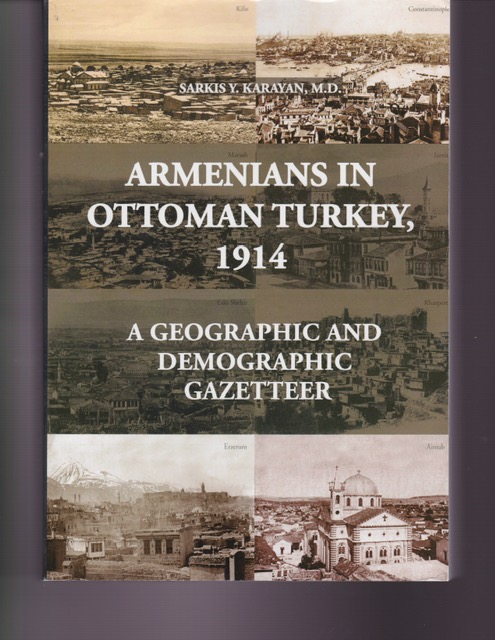
One simple — yet key — question set into motion 30 years of research: how many Armenians were actually massacred during the Armenian Genocide?
This question was posed to Dr. Sarkis Karayan in 1971, when he was serving as chief of the American University of Beirut’s Maternal and Child Health Center, by Dr. Stanley Kerr, chairman of the Department of Biochemistry at AUB. Close friends and esteemed colleagues, Kerr was working on his soon-to-be published book Lions of Marash, which focused on the eyewitness accounts of the American Near East Relief’s efforts during the Armenian Genocide. Kerr knew that Karayan was not only Armenian, but possessed the passion for history and research that would lead him to the accurate findings.
He was right.
Karayan made this quest one of his life’s missions and after countless hours of research and decades of dedication, Armenians in Ottoman Turkey, 1914: A Geographic and Demographic Gazetteer, was recently released by the Gomidas Institute, an independent and academic institution based in London (www.gomidas.org).

30.8.18

Turkey’s last Armenian village honors long-ago stand

Ayla Jean Yackley
 
Turkey’s sole remaining Armenian village endured an onslaught by the Ottoman army a century ago and a rebirth in a staunchly nationalist republic. Today, the inhabitants of Vakifli battle far different pressures that threaten the community’s survival.
Set atop a remote hill in Turkey’s Hatay province, Vakifli has seen its population dwindle in recent decades as younger generations depart to pursue employment, education or marriage elsewhere. The village, about 13 miles from the Syrian border, also has weathered the fallout from the seven-year conflict there. 

8.6.18

Armenia and Israel: The road to better relations

James Hasso
 
The Eastern Mediterranean region is not known for having the easiest of political situations. Two nations not typically focused on in tandem, but share similar struggles are the states of Armenia and Israel.
From both experiencing genocides, to being minorities surrounded by what can be considered hostile neighbors, Armenia and Israel have similar backgrounds. Despite that, due to geopolitics, including Israel’s relationships with Azerbaijan and Turkey, relations between the two nations are not where they would be expected to be.
Israel’s recent motion to recognize the Armenian Genocide (and the concurrent Assyrian and Greek Genocides) committed by Ottoman Turks and Kurds is commendable and certainly a great step in the right direction.

23.5.18

Israeli right shifts stance on Armenian genocide amid Turkey spat

Akiva Eldar
 
As long as I can remember, I've known that there was only one unique Holocaust in the history of humankind. We learned that the Armenians had suffered a “genocide” and that “a people’s massacre” had been perpetrated in Rwanda. We learned that Israel’s Arab citizens experienced a catastrophe, known in Arabic as the “Nakba,” when the state was established 70 years ago and they were uprooted from their homes. We were told that the use of the term “Shoah,” Hebrew for “Holocaust,” to characterize atrocities committed after World War II does a moral and historic injustice to the 6 million Jews exterminated by the Nazis.