Showing posts with label Ara Sarafian. Show all posts

13.11.18

From Mundane Details to Great Revelations

Taleen Babayan
 
One simple — yet key — question set into motion 30 years of research: how many Armenians were actually massacred during the Armenian Genocide?
This question was posed to Dr. Sarkis Karayan in 1971, when he was serving as chief of the American University of Beirut’s Maternal and Child Health Center, by Dr. Stanley Kerr, chairman of the Department of Biochemistry at AUB. Close friends and esteemed colleagues, Kerr was working on his soon-to-be published book Lions of Marash, which focused on the eyewitness accounts of the American Near East Relief’s efforts during the Armenian Genocide. Kerr knew that Karayan was not only Armenian, but possessed the passion for history and research that would lead him to the accurate findings.
He was right.
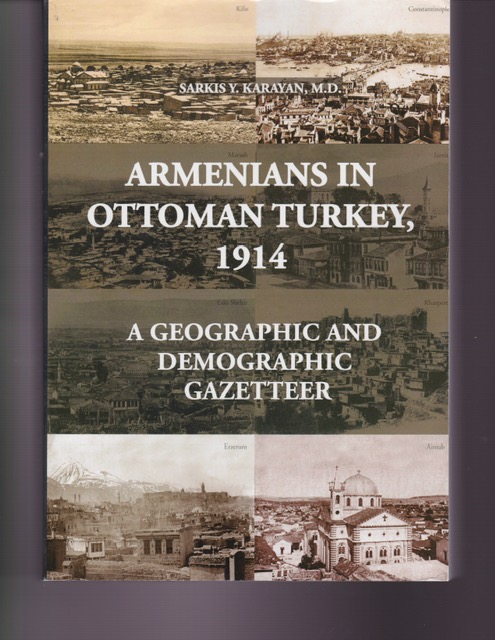
Karayan made this quest one of his life’s missions and after countless hours of research and decades of dedication, Armenians in Ottoman Turkey, 1914: A Geographic and Demographic Gazetteer, was recently released by the Gomidas Institute, an independent and academic institution based in London (www.gomidas.org).

3.5.15

In Eastern Turkey, Walking in the Shadow of Genocide

John Lubbock (*)
 
In the week leading up to the 100th anniversary of the Armenian Genocide, British-Armenian historian Ara Sarafian led a group of students, academics and journalists on a mission to engage with local Kurds and the descendants of Armenians in the Kurdish region of Turkey.
It was in these towns and villages, 100 years ago, that the Armenian population, as well as many Assyrians, were forced from their homes and killed or deported by the state and its deputies. The Ottoman bureaucracy, supposedly fearing non-Turkish populations would revolt and carve off Ottoman lands to create new nation-states, exploited tribal, class and ethnic tensions to encourage local Kurdish leaders to murder their neighbours and steal their lands.
Sarafian has been travelling to this region, and especially the main Eastern city of Diyarbakir, for years, engaging with locals and trying to build bridges with the local community.

21.4.15

Armenian Genocide: 100 Years Later, Turkey Replaces Armenian Memories With 'Restored', Whitewashed Sites

Erin Banco
 
YEMIŞLIK, Turkey -- The mosque in the center of this village in eastern Turkey looks new compared to the buildings around it. Sporting a fresh coat of green paint, it overlooks a group of crumbling houses, most of them abandoned, made of stones, sticks and steel sheets. There is virtually no trace of the once-famous village that Armenians view as one of the holiest places on earth.

5.1.15

A Century of Silence

Raffi Khatchadourian
I. RESURRECTION
When I try to imagine my grandfather, the face that appears to me is a variation of a pencil drawing that hangs in my parents’ house. The drawing captures the earliest image of him that we have in our family. He appears to be in his thirties, and he stares down from the wall with a serious countenance, a sharply groomed mustache, a tall, stiff collar, a tie pin. He seems like a self-possessed man, with an air of formality: a formidable person.
I never had the chance to meet him. I was born in the nineteen-seventies, on Long Island, and he was born in the eighteen-eighties, in the Ottoman Empire, near the Euphrates River. He died in 1959—the year that the first spacecraft reached the moon, Fidel Castro seized power in Cuba, and Philip Roth published “Goodbye, Columbus,” though I suspect he would have known nothing of those things. What he knew was privation, mass violence, famine, deportation—and how to survive, even flourish, amid such circumstances.

18.8.14

William Saroyan Street Named in Bitlis

The Bitlis town council has approved the renaming of five streets in this historic town in south-eastern Turkey. Among the names is “William Saroyan Street,” after the great American-Armenian writer whose ancestors came from Bitlis before 1915. Saroyan was born in Fresno but felt strong ties to his ancestral home. He visited Bitlis in 1964 and 2014 marks the 50th anniversary of that visit.

27.3.14

Exhibition of Bitlis Armenians Held in Tatvan

Ayse Gunaysu


March 1, 2014. We are at the municipality’s Cultural Center of Tatvan, a district of Bitlis, close to the city center. There is a poster in the entrance of the building announcing the exhibition: “Bitlis Armenians, March 1-2, Gomidas Institute (GI).”

11.6.13

Interview with Ara Sarafian

The following interview with historian Ara Sarafian, director of the Gomidas Institute (London), was published in the July 2012 issue of the French Armenian magazine "Nouvelles d'Armenie."
 
"Nouvelles d'Armenie": Going against the Vidal-Naquet doctrine, you believe that we should have a dialogue with deniers of the Armenian Genocide. Where are we in this issue? Where does this contradictory dialogue stand today?
Thank you for your forthright question. I will respond accordingly. I do not accept the basic premise of your question, as your reference to Naquet suggests, that deniers are all powerful, while their opponents are powerless and voiceless. Such a premise flatters deniers and masks the failures of their opponents. It provides us with a facile excuse to avoid critical scrutiny of our own work. Nor do I accept the view that engaging deniers bestows upon their views legitimacy that those views would not otherwise have enjoyed.     In Turkey today there is a long-awaited opportunity for open debate on the treatment of Armenians. There’s a perhaps unprecedented chance to publicly challenge the state orthodoxy. To squander this opportunity to educate Turkish society would be a great shame. 

8.5.12

97 Years Later, on the Road to Ayash…

The following article was published in the Turkish daily "Radikal" on 24 April 2012. The author accompanied historian Ara Sarafian on a trip to Ayash, on the trail of around 85 Armenian political prisoners who were sent there following the arrests in Constantinople on 24 April 1915. According to Sarafian, 70 of these prisoners were killed in the following few months. His trip was part of a broader project examining these arrests and the ultimate fate of the prisoners concerned.

9.5.11

“Talaat Pasha’s Report on the Armenian Genocide, 1917”

In 2008 Murat Bardakci, the Turkish journalist and historian, published a facsimile of a report on Ottoman Armenians from Talaat Pasha’s private archives. The report had been given to Bardakci by Talaat’s widow in 1982. In his own presentation of the untitled and undated report, Bardakci acknowledged that the materials he was presenting were open to interpretation. He called the report “A General Account of the Armenian Population after the Population Transfer [Tehcir] (possibly 1915-1916).”[1] Bardakci’s work was somewhat derided by Turkish nationalist historians and generally ignored by others.[2]