Showing posts with label Western Armenia. Show all posts

13.11.18

From Mundane Details to Great Revelations

Taleen Babayan
 
One simple — yet key — question set into motion 30 years of research: how many Armenians were actually massacred during the Armenian Genocide?
This question was posed to Dr. Sarkis Karayan in 1971, when he was serving as chief of the American University of Beirut’s Maternal and Child Health Center, by Dr. Stanley Kerr, chairman of the Department of Biochemistry at AUB. Close friends and esteemed colleagues, Kerr was working on his soon-to-be published book Lions of Marash, which focused on the eyewitness accounts of the American Near East Relief’s efforts during the Armenian Genocide. Kerr knew that Karayan was not only Armenian, but possessed the passion for history and research that would lead him to the accurate findings.
He was right.
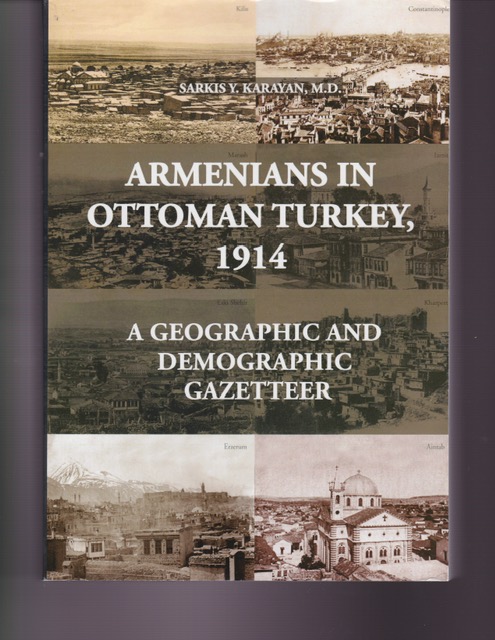
Karayan made this quest one of his life’s missions and after countless hours of research and decades of dedication, Armenians in Ottoman Turkey, 1914: A Geographic and Demographic Gazetteer, was recently released by the Gomidas Institute, an independent and academic institution based in London (www.gomidas.org).

10.8.17

‘Where Are You From?’ and the Huge Pile of Complexes

Rupen Janbazian
Translated by Tatul Sonentz-Papazian

“Where are you from?”
“Toronto… from Canada.”
“No! Before that…”
This was not an existential query directed at us; the man was not asking which corner of Western Armenia our forefathers came from, or where the birthplace of our Armenian origin was. The question was much more mundane—and, in its simplicity, a huge pile of complexes.
He wanted to know “where from” we had migrated to Canada. It was not the first time that strangers had asked us this question during this visit.

3.3.16

Tracing Family Roots: First-Ever Armenian Genealogy Conference to Be Held on April 9

The Armenian Genealogy Conference will take place April 9-10 in Watertown. The conference, which grew out of the Armenian Genealogy group on Facebook, will feature several speakers on various topics regarding Armenian genealogy, history, geography, and presentations on different organizations and initiatives.
George Aghjayan, a retired actuary and one of the conference organizers, noted that the study of Armenian genealogy has grown substantially over the last decade, and that organizing a conference was a necessary step. “Advances in technology have allowed access to information previously thought unattainable,” said Aghjayan, who hopes that the conference can become an annual event.

3.5.15

In Eastern Turkey, Walking in the Shadow of Genocide

John Lubbock (*)
 
In the week leading up to the 100th anniversary of the Armenian Genocide, British-Armenian historian Ara Sarafian led a group of students, academics and journalists on a mission to engage with local Kurds and the descendants of Armenians in the Kurdish region of Turkey.
It was in these towns and villages, 100 years ago, that the Armenian population, as well as many Assyrians, were forced from their homes and killed or deported by the state and its deputies. The Ottoman bureaucracy, supposedly fearing non-Turkish populations would revolt and carve off Ottoman lands to create new nation-states, exploited tribal, class and ethnic tensions to encourage local Kurdish leaders to murder their neighbours and steal their lands.
Sarafian has been travelling to this region, and especially the main Eastern city of Diyarbakir, for years, engaging with locals and trying to build bridges with the local community.

21.4.15

Armenian Genocide: 100 Years Later, Turkey Replaces Armenian Memories With 'Restored', Whitewashed Sites

Erin Banco
 
YEMIŞLIK, Turkey -- The mosque in the center of this village in eastern Turkey looks new compared to the buildings around it. Sporting a fresh coat of green paint, it overlooks a group of crumbling houses, most of them abandoned, made of stones, sticks and steel sheets. There is virtually no trace of the once-famous village that Armenians view as one of the holiest places on earth.

14.4.15

Remembering the Armenian genocide

Raffi Hovannisian
 
On April 24, 2015, a century closes circle upon the 1915 genocide and great national dispossession perpetrated by the Young Turk Party against the Armenian people.
This primer in premeditated nation-killing resulted not only in the deportation and murder of 1.5 million civilians on their native soil but also in the destruction of an entire civilization – nearly four millennia of continual presence in an ancestral cradle long mapped as Western Armenia.
The government of Turkey, which now occupies those lands, denies that a genocide ever took place there.
What shall I say on that April day, 100 years later, to my survivor grandfathers Kaspar and Hovakim, who had watched their parents and siblings killed by the sword or else taken away for conversion? Or to their wives, my grandmothers Siroon and Khengeni, the latter of whom was saved by a righteous Turkish neighbor?

2.2.15

The Hidden Armenians of Western Armenia

Matthew Karanian (*)
 
The village of Chunkush was home to about 10,000 Armenians, and hardly anyone else, until 1915.
That’s when the Armenians were driven out, and were marched for two hours to a ravine known as the Dudan Gorge. Once they arrived at the ravine, they were herded by the force of batons and bayonets into its depths. Here they died, if they hadn’t already perished before entering the abyss.
One young Armenian girl, not more than 10 years of age, stood at the edge of death. She was part of a group that had been marched to the ravine on one of the killing days—the day on which her Chunkush neighborhood had been selected for this “deportation.”

5.1.15

A Century of Silence

Raffi Khatchadourian
I. RESURRECTION
When I try to imagine my grandfather, the face that appears to me is a variation of a pencil drawing that hangs in my parents’ house. The drawing captures the earliest image of him that we have in our family. He appears to be in his thirties, and he stares down from the wall with a serious countenance, a sharply groomed mustache, a tall, stiff collar, a tie pin. He seems like a self-possessed man, with an air of formality: a formidable person.
I never had the chance to meet him. I was born in the nineteen-seventies, on Long Island, and he was born in the eighteen-eighties, in the Ottoman Empire, near the Euphrates River. He died in 1959—the year that the first spacecraft reached the moon, Fidel Castro seized power in Cuba, and Philip Roth published “Goodbye, Columbus,” though I suspect he would have known nothing of those things. What he knew was privation, mass violence, famine, deportation—and how to survive, even flourish, amid such circumstances.

4.1.15

Pilgrimage as/or Resistance

Nancy Kricorian

Before I leave home, I come up with a title for the Armenian Heritage Trip to Turkey: Twenty Armenians on a Bus, or The Thirty Handkerchief Tour. Our guide calls it a pilgrimage, and refers to us as pilgrims, as though we are on a religious or spiritual quest. What do I hope to find? Almost one hundred years have passed since my paternal grandmother and her family were driven from their home in Mersin in 1915, just a few months into the Ottoman government’s genocidal campaign that resulted in the deaths and exile of the vast majority of its Armenian citizens. Of her immediate family, only my grandmother and her brother survived the death march. They were among eight thousand Armenian orphans in a camp in the Syrian desert at Ras al-Ain.

5.9.14

The Blackberries of Kharpert

Eric Nazarian
 
It’s been an unspeakably bloody summer in the Middle and Near East. The awful war in Gaza, the beheading of James Foley, the sniper shootings on border villagers in Tavush, the endless mayhem and quagmire of Syria, the micro-war between Armenia and Azerbaijan inflamed by Aliyev’s Twitter threats to bomb Yerevan, and the Yezidi genocide perpetrated by ISIS that has created mushrooming humanitarian disasters all over the region.

27.8.14

Ani Ruins Reveal Hidden Secrets from Below


The underground secrets of the historic Ani ruins, an ancient, 5,000-year-old Armenian city located on the Turkish-Armenian border in the eastern province of Kars, have been revealed. (*)
While speaking at the recent “International Ani-Kars Symposium,” history researcher Sezai Yazıcı said secret water channels, undiscovered monk cells, meditation rooms, huge corridors, intricate tunnels, unbelievable traps and corners that make one lose their sense of direction were just some of the unknown underground structures located at the ancient site.
Yazıcı said a number of experts, academics and researchers attended the Kars symposium, which was held at Kars’ Kafkas University from August 14 to 16. At the symposium, Yazıcı’s presentation, entitled “Underground Secrets of Ani,” drew a lot of attention since no previous publications on the underground structures had been mentioned before.

27.3.14

Exhibition of Bitlis Armenians Held in Tatvan

Ayse Gunaysu


March 1, 2014. We are at the municipality’s Cultural Center of Tatvan, a district of Bitlis, close to the city center. There is a poster in the entrance of the building announcing the exhibition: “Bitlis Armenians, March 1-2, Gomidas Institute (GI).”

18.1.14

Armenian Official Suggests Renaming Armenia

Armenia’s Education and Science minister Armen Ashotyan proposed on January 17, 2014 that the official name of the country – the Republic of Armenia – be changed to the Republic of Eastern Armenia.
Historically, Armenia has been divided into Eastern and Western Armenia, Eastern Armenia being part of the Persian Empire until the beginning of the 19th century, before it became part of the Russian Empire. Part of Eastern Armenia later became the First Republic for two short years before it was seized by the Bolsheviks to become the Soviet Armenian Republic. In 1991, it was proclaimed as the independent Republic of Armenia.

9.10.13

The Men from Moush

Maria Titizian
 
Developing complex models and postulating theories, writing academic papers, organizing high-level conferences and advancing policies to address some of the most pressing issues facing the Armenian nation is typically the method we employ. We discuss and analyze, argue incessantly, lose our composure in the melee of verbal and pseudo-intellectual traffic and usually end up nowhere.
One of the most crippling problems in contemporary Armenian life is the divide or disconnect between our two selves – the homeland and the Diaspora. We have yet to find the right formula that will help us to see the world and ourselves with a common vision and end game.
Sometimes the answers are so very simple. Case in point, the men from Moush.

23.9.13

Internalizing Western Armenia

Varak Ketsemanian
 

Nineteen-fifteen was the date that separated a significant part of the Armenian Nation from not only its homeland, but from the historical reality as well. Western Armenia was marginalized from the collective concerns and reality of the Armenians living in the diaspora, as if the genocide had eradicated it from the hearts of its inhabitants. The severity of this marginalization is evidenced by the fact that no serious and sustained contact has been made with it since 1915, which has led us to the alienation of Western Armenia and consequently to its “taboo”-ization.

24.7.13

Family Memories Published in Long-Running Church Newsletter Series

Elise Kalfayan
 
What was daily life like in Western Armenian provinces and communities before the Genocide, and how did families adapt as they emigrated to the U.S.? Stories and memories passed down to parishioners of United Armenian Congregational Church, printed in the church’s Herald publication over the past four years, are a rich source of cultural history.
Starting with Gesaria/Kayseri, series editor Joyce Abdulian selected regions and asked church members to contribute family memories. Launching the series, she wrote “The Herald hopes to continue featuring family life in the old country as part of our Armenian heritage and culture…” The response was very enthusiastic, and continues to the present as UACC looks forward to celebrating its 50th anniversary.

16.7.13

More Destruction of Armenian Heritage Sites in Turkey

Collectif 2015: Réparations

While new acts of destruction of Armenian heritage sites are taking  place in Turkey, as a continuation of the politics of effacing the Armenian past in the wake of the genocide of the Armenians at the beginning of the 20th century, the Collective 2015: Réparations joins those in Turkey who have dared to oppose these political operations of the State.
The destruction of Armenian heritage sites continues at this very moment under cover of urban renewal projects, as several articles of such newspapers as Agos, Radikal and also Taraf  in Turkey have pointed out.

8.6.13

In a Turkish Town That Had 10,000 Armenians, Now There Is Only One

Chris Bohjalian
 
A woman I met last month in southwestern Turkey is going to die, probably sometime soon. Asiya’s death will not be covered by any news service, and for all but a few people in her small village of Chunkush, she will not be missed. Even the relatives who love her will probably think to themselves, well, she was 98 years old. Or 99. Or, if she survives until 2015, somewhere in the neighborhood of a century. She will have lived a long life.


13.2.13

A Cathedral on the Verge of Collapse: The Campaign to Save Mren

Lucine Kasbarian

Dr. Christina Maranci, Arthur H. Dadian and Ara T. Oztemel Associate Professor of Armenian Art and Architecture at Tufts University in Medford, Mass., has issued a call to save the 7th century Mren Cathedral of Western Armenia, located in the Kars region of present-day Turkey. Prof. Maranci’s areas of expertise include Byzantine art and architecture, and the art and architecture of the Transcaucasus—principally Armenia. She is considered one of the world’s authorities on the Mren Cathedral.

10.2.13

Save Mren

Christina Maranci
 
Dr. Christina Maranci, Arthur H. Dadian and Ara T. Oztemel Associate Professor of Armenian Art at Tufts University, has issued the following call to save a remarkable church of Western Armenia, now in Turkish territory.