“Every movie needs a rabbi,” Samuel Goldwyn once wrote. His comment
seems relevant to two movies bowing this weekend, both in urgent need of
help. One has a world-class rabbi, the other an invisible one.
Oprah
Winfrey, as mega-energized as ever, has gone multimedia pitching her
new film, whose title is as complex as its plot line. Fortunately, The Immortal Life of Henrietta Lacks
is an HBO movie, so there’s no panic about its box office opening. Only
Oprah could stir excitement for the story of an African-American woman
whose tissue samples in 1951 proved so resilient that they created the
basis for drugs to combat cancer or AIDS.
But if that one-liner might be a hard sell, consider The Promise,
a sprawling $100 million epic dealing with the Armenian genocide of
1915. That film stars Christian Bale and Oscar Isaac and is directed by
Terry George (who shot Hotel Rwanda). Its “rabbi,” Kirk Kerkorian,
personally put up most of the production cost but died just before the
start of production. Although he loved movies – he had bought and sold MGM three times — Kerkorian harbored serious doubts about making this one, which opens Friday on 2,000 screens.
If history was any guide, the director Terry George figured there’d be weirdness around his new film, “The Promise,” about the Armenian genocide. Sure enough, he was right.
One
of the actors, Daniel Giménez Cacho, said he was contacted before
filming by a Turkish ambassador. In line with Turkey’s official stance,
the diplomat insisted that the genocide, in which nearly 1.5 million
Armenians were killed, had never occurred. After the movie’s premiere at
the Toronto International Film Festival in September, it racked up 55,000 lowly one-star votes
on the Internet Movie Database, which is quite something, considering
only a few thousand people had actually seen it at the three public
screenings.
And
then, six weeks before “The Promise” hit theaters this weekend came
another film that shared uncanny parallels. Like “The Promise,” “The Ottoman Lieutenant”
hinges on a love triangle set in Turkey during the early days of World
War I. Unlike “The Promise,” “The Ottoman Lieutenant,” which stars
Michiel Huisman and Josh Hartnett, was backed by Turkish investors and
has been pilloried by critics for whitewashing historical events.
Ben Kingsley and Josh Hartnett and Hera Hilmar surely would not have signed on to star in The Ottoman Lieutenant if they even imagined they would be parties to genocide denial.
And
screenwriter Jeff Stockwell—who is by every indication a very decent
person—says that everybody he spoke to in connection with the making of The Ottoman Lieutenant
was aware of the Turkish government’s longtime denial of responsibility
for the deliberate murder of 1.6 million innocent Armenians.
“The
desire to be sure we were not supporting that denial weighed on me and
everyone else I talked to who was hired on to the project—so much so
that the climax of the film is built around the leads interrupting a
death march,” Stockwell said in an email to The Daily Beast.
The movie—which came out in March and is reported by the website Box Office
Mojo to have taken in less than $250,000 in American theaters despite
its big-name cast—indeed has a scene where Turkish soldiers are herding
Armenian civilians on a death march, complete with summary executions.
Imagine, for a
moment, that after the Holocaust the official German position was one of
denial. That the German heads of state have, since 1945, consistently
asserted that the events of the Holocaust were nasty, yes, but both the
Jews and the Germans bear some responsibility, and in the end, well,
such things happen in times of war. It’s a disgusting thought. But now,
imagine further – not only do the Germans take this position, but much
of the world, including the United States, a country whose leaders and
soldiers saw the camps and the corpses, participates in the denial. They
allude to certain “facts” and “regrettable horrors” but they refuse to
utter the only responsible word – genocide. Putrid, no?
This is the present situation of the Armenians. I should not have to
ground the Armenian Genocide in comparisons to the Holocaust to
illustrate its horror, it was a genocide, and is thus reserved a
special, terrible place in human history all its own (indeed, the word
“genocide” was coined by Raphael Lemkin precisely in response to the
Armenian Genocide). It should be enough to say, “here a genocide
occurred, and it remains unacknowledged,” but, as we have seen, this is
not enough. The United States has not yet formally recognized the
Armenian Genocide, nor has the U.K., nor (most upsettingly) has Israel,
nor have a host of other countries. Even the countries that do formally
recognize the Armenian Genocide only adopted this position, largely,
within the past 20 years despite the fact that the genocide occurred in
1915 (though, the events directly leading up to the genocide began far
earlier, and killings took place until 1923).
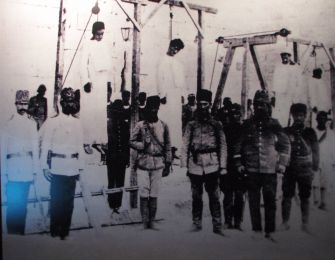
wikimedia
The fact of the Armenian Genocide is beyond dispute. The Armenians, a
Christian people living primarily in eastern Anatolia, had long been
the subject of Ottoman animus due to religious and ethnic tensions.
Between 1894 and 1896, Sultan Abdul Hamid II sparked a two year long
campaign of violence (which, had it taken place in Eastern Europe
against the Jews, would be called a “pogrom”) against the Armenian
population of the Empire. Employing the help of the empire’s Kurdish
population (who carried out many of the killings during the genocide as
well – though many Kurdish groups, as opposed to Turkey, have since
recognized and apologized for their role in the genocide), the Ottomans,
both in official state actions and the actions of state sanctioned
mobs, murdered between 50,000 and 300,000 Armenians (this is a wide
range, but there is no formal agreement on the numbers). They also
murdered a large number of Assyrians and other Christian minorities as
well (the Assyrian and Greek minorities were also targeted during the
years of the Armenian Genocide). The two year period of violence would
would come to be known as the Hamidian Massacres.
Cut forward 20 years to 1914, and the Ottoman Empire is newly under
the control of the Committee of Union and Progress (CUP), otherwise
known as the Young Turks. Though the CUP was a Western oriented,
modernizing movement, it was still decidedly anti-Armenian, and, when
World War I broke out, the CUP leadership saw the global chaos as the
perfect cover to carry out their campaign of extermination. While
scholars continue to debate exactly when the events of the Armenian
Genocide began, it is widely agreed that the genocide proper began
around April, 1915.
wikimedia
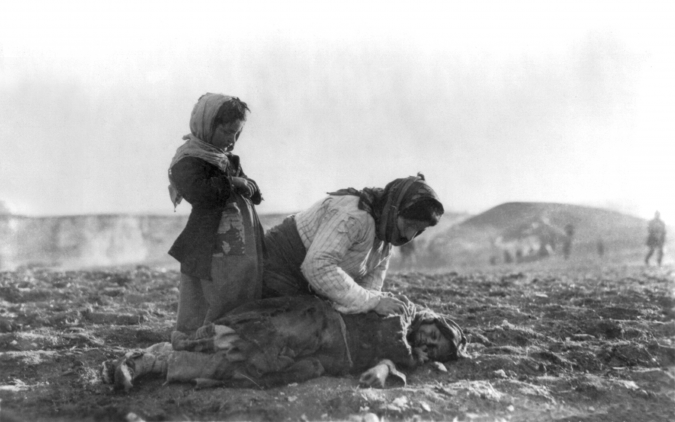
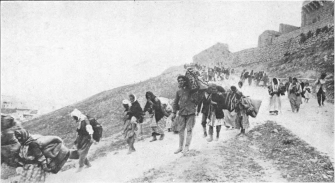
Unlike the Holocaust, the Armenian Genocide was not a rigidly
structured, mechanized, industrial effort. Rather, the killings largely
took the form of death marches, in which Armenians were forced from
their homes for “relocation,” then marched through the Empire until they
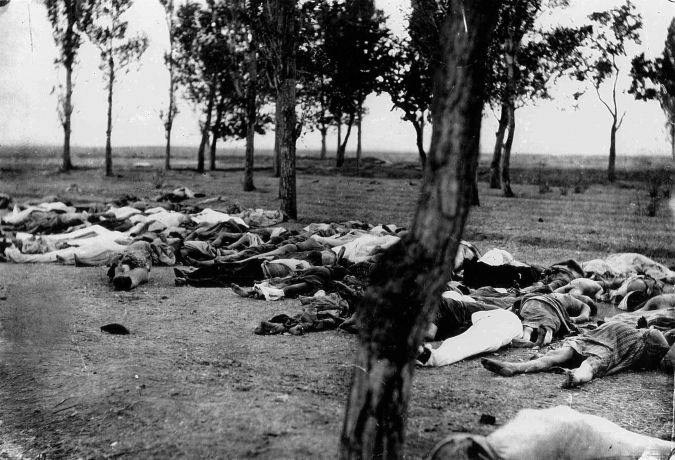
perished from exhaustion, disease, exposure, or starvation. In addition
to the marches, there were more straightforward mass killings by the
Ottoman military as well as bands of mobile executioners (many of whom
were criminals released from prison precisely for this purpose) that
operated much like the Nazi Einsatzgruppen. Those Armenians that weren’t
killed were either used as slave labor (and then murdered), sold into
sex slavery, or forcibly converted to Islam.
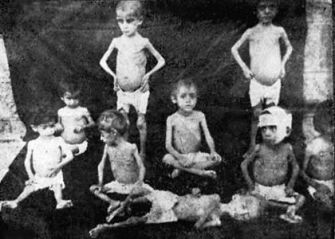
When
the genocide finally ended in 1923, around 1.5 million Armenians had
been killed or displaced, the region of Armenia almost entirely purged
of its historic people. To further drive this devastation home, the
Armenian population of the Ottoman Empire, prior to the genocide
comprised only 2 million people. The genocide destroyed 75% of the
entire Ottoman-Armenian population.
So why, in the face of such indisputable and monstrous facts, do we
continue to the deny the existence of the Armenian Genocide? This
refusal stems from a moral cowardice in the face of Turkish threats. The
official position of the Turkish government, which has remained
consistent since 1914, has been to deny the facts and to reframe the
narrative of the genocide. The Turkish government frames the events of
the Armenian Genocide as the natural consequence of war. The genocide
largely took place during World War I, and the Turkish government often
cites examples of Armenian self defense (like the uprising at Van) as
proof that the Armenian population represented a genuine fifth column
during the war, and thus it was relocated due to military concerns. Some
go further and assert that the genocide was in actuality, nothing more
than particularly bloody civil war, in which the Armenians committed as
many atrocities as the Turks.
wikimedia
The world knows that this is false, and yet, in order to preserve
“good” relations with Turkey (how one can maintain positive relations
with a genocide denying dictator is another question), countries around
the world commit moral suicide and acquiesce to the demands of those who
would cover the perpetration of a genocide at the expense of the
victims.
It is against this background that the forthcoming film “The
Promise,” (in theaters April 21st) starring Oscar Isaac, Charlotte Le
Bon, and Christian Bale, was made. The film, directed and cowritten by
Terry George (who also directed “Hotel Rwanda,” a film about the Rwandan
Genocide), follows the story of a love triangle between the Armenians
Michael (Isaac) and Ana (Le Bon) and American Journalist Chris (Bale).
This love story, spanning over a year or so, is set against the backdrop
of World War I and the Armenian Genocide, with the characters both
dispersed and reunited by the genocide.
Michael is a young, aspiring doctor who leaves his village in Armenia
for Constantinople to study medicine. In the city, Michael stays in the
home of his wealthy uncle and quickly befriends a fellow medical
student, Emre (played by Marwan Kenzar) with powerful connections to the
Turkish military. In his uncle’s home, Michael meets Ana, an Armenian
raised in Paris looking to get back in touch with her roots. A romance
is immediately in the works between the two characters, but we soon
learn that Ana is romantically involved with Chris, a gruff but selfless
journalist with the Associated Press who is in Turkey to cover the war.
The atrocities to come are hinted at in the beginning of the film, but
seem to materialize out of nowhere (notably, the sporadic appearance of
Germans in the early Constantinople scenes always makes the characters
uneasy. It is well known that Hitler was an admirer of the Armenian
Genocide, but what is less known is that the Germans were highly
complicit in its perpetration, having had knowledge of the events and
the requisite control over the Ottoman military and government to have,
at the very least, dampened the efficacy of the Ottomans’ pursuit).
Predictably, Ana and Michael fall in love just as the roundups of
prominent Armenian intellectuals and businessmen begin. Michael is
deported and forced into slave labor in the mountains, and the two are
separated. In the meantime, Chris travels around the empire catching
glimpses of the atrocities being committed upon the Armenian population
(a hanging body, a burnt and pillaged town, a death march) and reporting
back to America. I won’t spoil the story, but you can probably guess
how things go.
As a story, and as a film, “The Promise” is a routine, incredibly
maudlin, somewhat disjointed affair – the film’s Turkish villains are so
clichéd as to be almost cartoonish figures of evil, the plot turns are
often abrupt and unexplained, and very little context is given for the
genocide itself, which is the real subject of the film. The performances
of the three stars are all good, and it is competently done and
emotionally moving – there are no glaring missteps and I imagine that
most people will find it perfectly watchable (I certainly did) – but, as
a film, it does not rise to the level of George’s “Hotel Rwanda” nor
does it even begin to approach Spielberg’s “Schindler’s List” (a film
with its own set of problems).
wikimedia
But, we must ask, does any of this matter? For all its shortcomings,
“The Promise” is the first big budget, star driven film about the
Armenian Genocide to be released (The 2002 Canadian-French film
“Ararat,” a semi-large release, explored the fictional creation of a
movie about the Armenian Genocide, but did not center on the the events
of the genocide itself), the importance of which cannot be understated
(prior efforts to release a big budget Armenian Genocide film, primarily
adaptations of Franz Werfel’s 1933 novel “Forty Days of Musa Dagh,” all
collapsed in the face of Turkish threats). During the Q&A with
Terry George that followed the screening of the film at the Dolby 88
Screening Room in New York City, the director stressed that he knew the
film was “old-fashioned,” but the goal was to reach as wide an audience
as possible, and certain aesthetic sacrifices had to be made in that
pursuit (for instance, the film is largely lacking in any graphic
depictions of violence because George wanted to procure a PG-13 rating
to ensure a larger viewership). In this regard, George had an incredibly
fine line to toe – make the film too true to life (to the extent that
any genocide film can be “true to life”) and it will be too difficult
for mass appeal; make the film too well suited to popularity, and you
risk cheapening the genocide. “The Promise” represents a competent
effort to toe this line – not an enviable task.
Furthermore, we must acknowledge that there is no aesthetic roadmap
for a large film about the Armenian Genocide. The Holocaust, and I know
this phrase is a bit disgusting in this context, is simply more
aesthetically developed in the popular imagination. It has frequently
been the subject of film and literature and has been somewhat
successfully absorbed into the common aesthetic vernacular (films
frequently borrow the aesthetics of the concentration camps [the shaved
heads, the threadbare uniforms, the barracks] and the Nazi party [the
red and black, the leather, the imposing architecture] to signify state
evil). A large budget portrayal of the Armenian Genocide is sui generis,
and therefore, in order to help ensure its mass-appeal, must ground
itself in other cinematic clichés (thus the accusation of “old
fashioned”) – the aesthetic clichés of the Armenian Genocide having yet
to develop in the American consciousness.
wikimedia
What’s more, many people simply cannot put a face on Armenia or the
Armenian Genocide. Unlike Jews, Armenians are not an especially visible
group in popular culture. Though none of the lead actors of “The
Promise” are Armenian, at least now, after seeing the film, people can
put an attractive face on the past – when you read that 1.5 million are
killed or displaced, you read a number; when you watch Oscar Isaac work
as a slave or mourn over a pile of rotting corpses, you see a person.
This is one of the purposes of cinematic or literary portrayals of
genocide (a pursuit that ought to make us ethically uneasy in many
respects), to reestablish the subjectivity of the victim out of the
cold, unimaginable mass. (There’s a famous quote attributed to Joseph
Stalin - “the death of one person is a tragedy, the death of one million
is a statistic.”)
In this regard, “The Promise” is an incredibly important first step
towards opening the film industry to this subject matter (though, the
film was privately funded by the late Kirk Kerkorian, a wealthy Armenian
businessman, and therefore was insulated from the pressure that the
Turkish government is able to exert on the major studios that depend on
foreign markets for their profits). To find an analogue in the world of
Holocaust films – there is likely no “Son of Saul” (the most brutal and
accomplished film of the genre – a complete abandonment of aesthetic
safety) without there first being a “Schindler’s List” (also a
successful film, but one that, as opposed to “Saul,” plays in Hollywood
clichés to a larger degree). When a crime like the Armenian Genocide has
gone unacknowledged for so long, the concerns of aesthetic success must
be secondary to the concerns of education. Films of great quality will
come; right now, it’s simply more important that people know what
happened.
“The Promise,” then, puts us in an interesting position
– acknowledging that a film is mediocre yet rooting for its utmost
success. I deeply, truly, want this film to be a smash hit, for it to
shatter box office records, aesthetic concerns be damned. I want this
film to be the beginning of a renewed interest in the Armenian Genocide,
a renewed shame at our government’s refusal to acknowledge it, a
renewed anger. I want this film to spark a public outcry, for us to
begin to work towards redeeming, to the extent that we can, 100 years of
cowardice. Because the refusal to acknowledge a genocide, any genocide,
is a crime in itself, one that not only debases the deniers, but also
rewards the perpetrators. And as long as one state can dictate the terms
of memory for much of the world, then a precedent has been set for
future perpetrators – the gravest crime on earth means nothing in the
face of economic or military concerns (indeed, this was the German
calculation during World War I). See this film, or don’t – the
important thing is that, at the very least, you educate yourself about
the Armenian Genocide, and remain enraged, always, in the face of
denial.
Read more: http://forward.com/culture/film-tv/367531/you-must-watch-this-new-film-on-the-armenian-genocide-whether-its-any-good/
Imagine, for a moment, that after
the Holocaust the official German position was one of denial. That the German
heads of state have, since 1945, consistently asserted that the events of the
Holocaust were nasty, yes, but both the Jews and the Germans bear some
responsibility, and in the end, well, such things happen in times of war. It’s
a disgusting thought. But now, imagine further – not only do the Germans
take this position, but much of the world, including the United States, a
country whose leaders and soldiers saw the camps and the corpses, participates
in the denial. They allude to certain “facts” and “regrettable horrors” but
they refuse to utter the only responsible word – genocide. Putrid, no?
A
neighbor once asked me how I knew that the Holocaust actually happened.
I was able to point out that a mutual friend of ours, Irene, had lived
as a child under Nazi occupation in Amsterdam. Her father died in a
concentration camp for harboring Jews. She had carried messages for the
resistance in the handlebars of her bicycle to other resistance fighters
in town. She was there when the survivors of the camps arrived back in
Amsterdam on buses, walking skeletons still in their striped uniforms.
But
Irene was 11 years old when the Nazis invaded Amsterdam. Today she is
83. The men and women who stumbled off those buses have passed now.
Meanwhile, white supremacists, neo-Nazis and Holocaust deniers have
started running campaigns of anti-Semitic fliers, rallies and even
speaking engagements on 63 college campuses in the United States. As
time marches on, it becomes easier to forget; easier to ignore the
lessons of history. Easier to deny.